Palm oil is used in a wide range of everyday products, from food and personal care items to oleochemicals and biofuels. Because the supply chain is complex, responsible sourcing requires more than policy commitments. Producers to consumers need to know where their raw materials come from, how they are produced, and whether risks are being addressed on the ground. This is where traceability matters.
Sustainable palm oil traceability refers to the ability to track palm oil and palm kernel products across the supply chain, from the plantations to mills, refineries, and final products. However, traceability is not simply about collecting data. At Musim Mas, traceability is the means in our responsible sourcing efforts: it helps us understand our supply base, identify the associated risks, engage suppliers, and demonstrate progress towards responsible and deforestation-free sourcing. Simply put, traceability provides the foundation for accountability.
What Is Sustainable Palm Oil Traceability?
Palm oil traceability is the process of mapping the movement of palm oil products through the supply chain. This includes identifying the smallholders, plantations, mills, and processing facilities involved in the production and movement of palm oil.
There are two important levels of traceability in palm oil supply chains:
Traceability to Mill (TTM)
Refers to the ability to trace palm oil products back to the mill where the fresh fruit bunches were processed. This helps companies understand which mills supply their refineries or processing facilities.
Traceability to Plantation (TTP)
Goes further by tracing palm oil products back to the plantation, estate, or smallholder farm where the fresh fruit bunches were grown. This provides a more detailed view of the crop’s origin and enables stronger risk assessment.
Why Traceability Is More Than a Data Exercise
Traceability is sometimes viewed as a technical process: collecting supplier names, maps and/ or coordinates, volumes, and documentation. While these data points are important, they are only useful when they support better decision-making.
For Musim Mas and buyers of palm oil products, traceability helps answer several practical questions:
· Where are the fresh fruit bunches produced?
· Are the supply areas linked to deforestation, peat, or conservation risks?
· Which suppliers require closer engagement or support?
· How can we prioritize action in complex landscapes?
· How can we demonstrate progress against our sustainability commitments?
This is why traceability is not a final outcome. A traceable supply chain is valuable because it enables companies to monitor risk, verify progress, and take action where needed.
Traceability and Deforestation-Free Sourcing
One of the most important roles of traceability is supporting deforestation-free sourcing. Palm oil has faced scrutiny because of its historical links to deforestation and peatland development. While the sector has made tremendous progress, continued accountability depends on companies being able to identify where their palm oil comes from and whether their suppliers are aligned with sustainability commitments.
Traceability data allows companies to connect supply origins with risk assessment tools, satellite monitoring, conservation maps, and supplier engagement processes. This helps identify areas where risks may be higher and where further verification or engagement is needed as is the approach Musim Mas takes.
Traceability also supports our No Deforestation, No Peat, No Exploitation (NDPE) commitments and Sustainability Roadmap. It allows us to move beyond broad policy statements and assess whether our supply chain is aligned with those commitments in practice.
How Musim Mas Approaches Traceability
For Traceability to Mill, Musim Mas requires key information such as the parent company name, mill name and address, and the volume of products supplied to our facilities. This enables us to identify the mills that supply our refineries and kernel crushing facilities.
For Traceability to Plantation, Musim Mas requires more detailed information. This may include the company name, plantation name, plantation maps, concession size, and information on smallholder farm locations or village-level sourcing areas.
This information supports our broader sustainability work by feeding into risk assessment, supplier engagement, and progress monitoring.
Musim Mas has achieved 100% Traceability to Mill for Crude Palm Oil and Palm Kernel across our global facilities, and 98% overall Traceability to Plantation as of 2025. These scores have been independently verified by Control Union.
This independent verification is important because it strengthens confidence in the accuracy and completeness of the traceability process. It also reinforces the message that traceability is not only internally monitored, but subject to external review.
From Traceability to Risk Management
Traceability becomes meaningful when it is connected to risk management. Musim Mas uses traceability data as part of its Risk Management Framework to identify, assess, mitigate, and monitor risks linked to our NDPE commitments. This includes both Musim Mas-owned operations and third-party suppliers, including mills, concessions, smallholders, and outgrowers.
TTP data helps Musim Mas understand where fresh fruit bunches are sourced from. This information can then be overlaid with forest areas, peat areas, and other landscape-level indicators to classify supply areas by risk level.
Where higher-risk suppliers or sourcing areas are identified, traceability enables more targeted engagement. Rather than treating all suppliers the same, Musim Mas can prioritize action where the risk is greatest and work with suppliers to address specific issues.
This is what makes traceability a practical tool. It helps translate sustainability commitments into action.

Traceability Data to Responsible Sourcing Outcomes
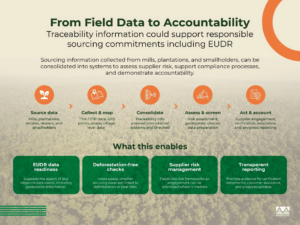
Traceability only becomes meaningful when the data can be used to support action. Once sourcing information is collected from mills, plantations, and smallholders, it can be consolidated into systems that help companies assess supplier risk, support compliance processes, and demonstrate accountability. This is increasingly important in the context of regulations such as the EU Deforestation Regulation (EUDR), where traceability is a major part of due diligence process.
Over 40% of palm oil produced across the industry originates with smallholders who seller to sub-agent and agents. The agents in turn sell to mills. Musim Mas as a large Group, has average of 600 over mills in its supply chain annually. This complexity is one reason why traceability cannot be addressed through technology alone. It also requires supplier engagement, field verification, capacity-building, and collaboration with local stakeholders.
Musim Mas works with third-party suppliers to support mapping and traceability activities. This includes helping suppliers understand what data is required and how traceability can be used to improve responsible sourcing. Musim Mas also supports independent smallholders through training programs that cover good agricultural practices, NDPE commitments, legal requirements, and access to more sustainable production practices.
By linking traceability with smallholder engagement, companies can avoid treating smallholders as a data gap. Instead, traceability can become a pathway to inclusion, support, and long-term improvement.
The Business Value of Traceability
Traceability also matters from a business perspective. Customers, regulators, investors, and civil society increasingly expect companies to demonstrate responsible sourcing. In many markets, sustainability claims must be supported by credible data and clear due diligence processes. Regulations such as the upcoming European Union Deforestation Regulation (EUDR) may require companies to provide traceability information and supply chain disclosures for due diligence process.
For companies sourcing palm oil, traceability can help strengthen buyer confidence, support regulatory compliance, and reduce exposure to reputational and operational risks. It also enables more informed procurement decisions by showing where supply originates and where additional engagement may be needed.
For a group that prides itself on being a leading sustainable palm oil major, Musim Mas sees traceability is part of a broader responsible sourcing approach. It supports our NDPE commitments, informs our Risk Management Framework, strengthens supplier engagement, and helps us demonstrate progress towards deforestation-free and responsible palm oil supply chains.
Frequently Asked Questions
What is palm oil traceability?
Palm oil traceability is the ability to track palm oil products through the supply chain, from mills and plantations to processing facilities and final products. It helps companies understand where palm oil comes from and whether sourcing practices align with sustainability commitments.
What is the difference between Traceability to Mill and Traceability to Plantation?
Traceability to Mill identifies the mill that processed the fresh fruit bunches. Traceability to Plantation goes further by identifying the plantation, estate, or smallholder farm where the fresh fruit bunches were grown.
Why does traceability matter for sustainable palm oil?
Traceability helps companies identify environmental and social risks, assess supplier performance, support NDPE commitments, and demonstrate progress towards responsible sourcing.
How does traceability help prevent deforestation?
Traceability enables companies to identify where palm oil is produced and assess whether supply areas overlap with deforestation, peat, or conservation risks. This helps companies prioritize supplier engagement and take action where risks are identified.
Is traceability enough to prove sustainability?
No. Traceability is an important foundation, but it is not the same as sustainability. Traceability must be connected to risk assessment, supplier engagement, monitoring, remediation, and independent verification.
How does Musim Mas verify its traceability progress?
Musim Mas’ Traceability to Mill and Traceability to Plantation scores have been independently verified by Control Union. This supports confidence in the accuracy and completeness of the reported traceability information.