By: Devane Sharma
This competition is part of the on-going partnership between the University of Cambridge, Eidgenössische Technische Hochschule Zurich (ETH Zurich), and Musim Mas
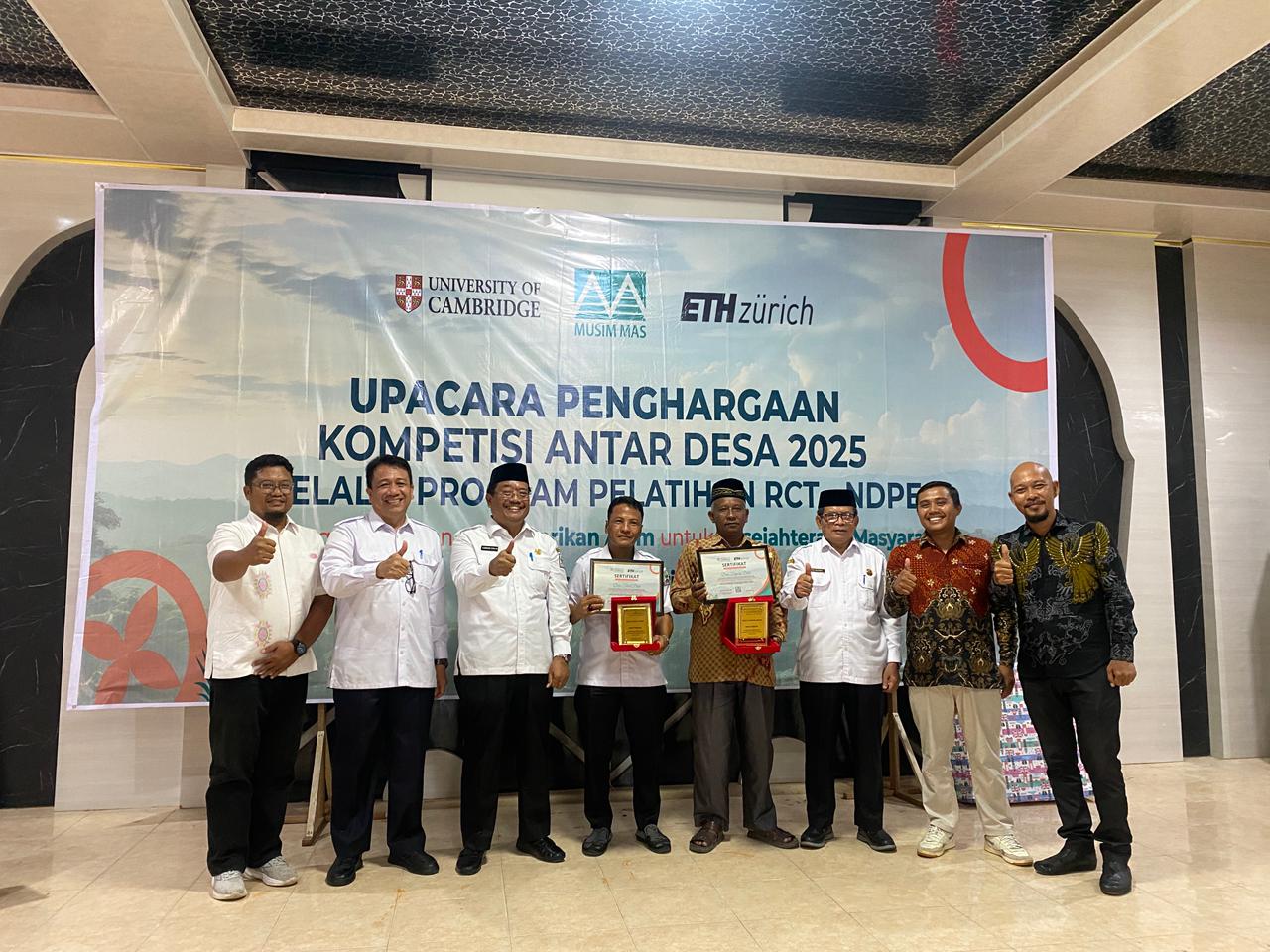
The 2025 winning village with the Bupati (Head of Regency Government) of Aceh Singkil and the field project implementor team at the intervillage competition award ceremony.
For many sustainability initiatives in agricultural supply chains, a central challenge remains unresolved: how can forest conservation goals be aligned with the economic realities faced by smallholder farmers?
Across the palm oil sector, interventions such as training programmes, certification schemes, and No Deforestation, No Peat, No Exploitation (NDPE) commitments have become increasingly common. Yet despite significant investment, there remains limited causal evidence on which approaches most effectively influence long-term behavioural change at the landscape level.
To address this gap, Musim Mas is collaborating with the University of Cambridge and ETH Zurich on a multi-year empirical research project in Aceh Singkil and Kota Subulussalam, two regencies in Aceh, Indonesia. Running from 2021 to 2027, the study examines whether behavioural and norm-based interventions can support forest conservation while enabling smallholders to remain part of sustainable palm oil supply chains.
Rather than relying primarily on material incentives or sanctions, the project explores how social norms, comparative feedback, and community collaboration can positively influence land-use behaviour over time.
Moving Beyond Conventional Sustainability Interventions
The project is structured as a randomized controlled trial involving more than 80 villages across Aceh. Villages are randomly selected to receive a new norm-based training intervention developed as part of the research collaboration.
The intervention builds upon existing NDPE awareness efforts while introducing activities designed to promote pro-environmental social norms at the community level. These activities include team-building exercises, public commitments to conservation-oriented behaviour, and comparative feedback on environmental performance.
Central to the approach is the concept of gotong royong — the Indonesian principle of cooperation and collective responsibility. The research team is examining whether strengthening community-level norms around conservation can encourage more durable behavioural change compared to approaches focused solely on compliance or financial incentives.
Prof. Rachael Garrett, Moran Chair of Conservation & Development at the University of Cambridge and lead researcher for the study, explained, “Private sector approaches to supply chain sustainability have historically focused on supply chain access, premium prices, and good agricultural practices to encourage farmers to adopt more sustainable behaviours. In this collaboration we wanted to go further and try something new, focussing on enhancing understanding of the community-level benefits of conservation and leveraging the strong social norms and community cohesion already present in oil palm landscapes to foster ideas about conservation as a civic duty. We believe these ‘non-monetary’ or ‘norm-based’ approaches may have the potential to produce more durable changes to farmer behaviour.”
Because villages are selected at random to receive the intervention, researchers can compare outcomes between participating and non-participating villages over time, helping isolate whether the norm-based approach itself contributes to observed differences.
Introducing the Inter-Village Competition
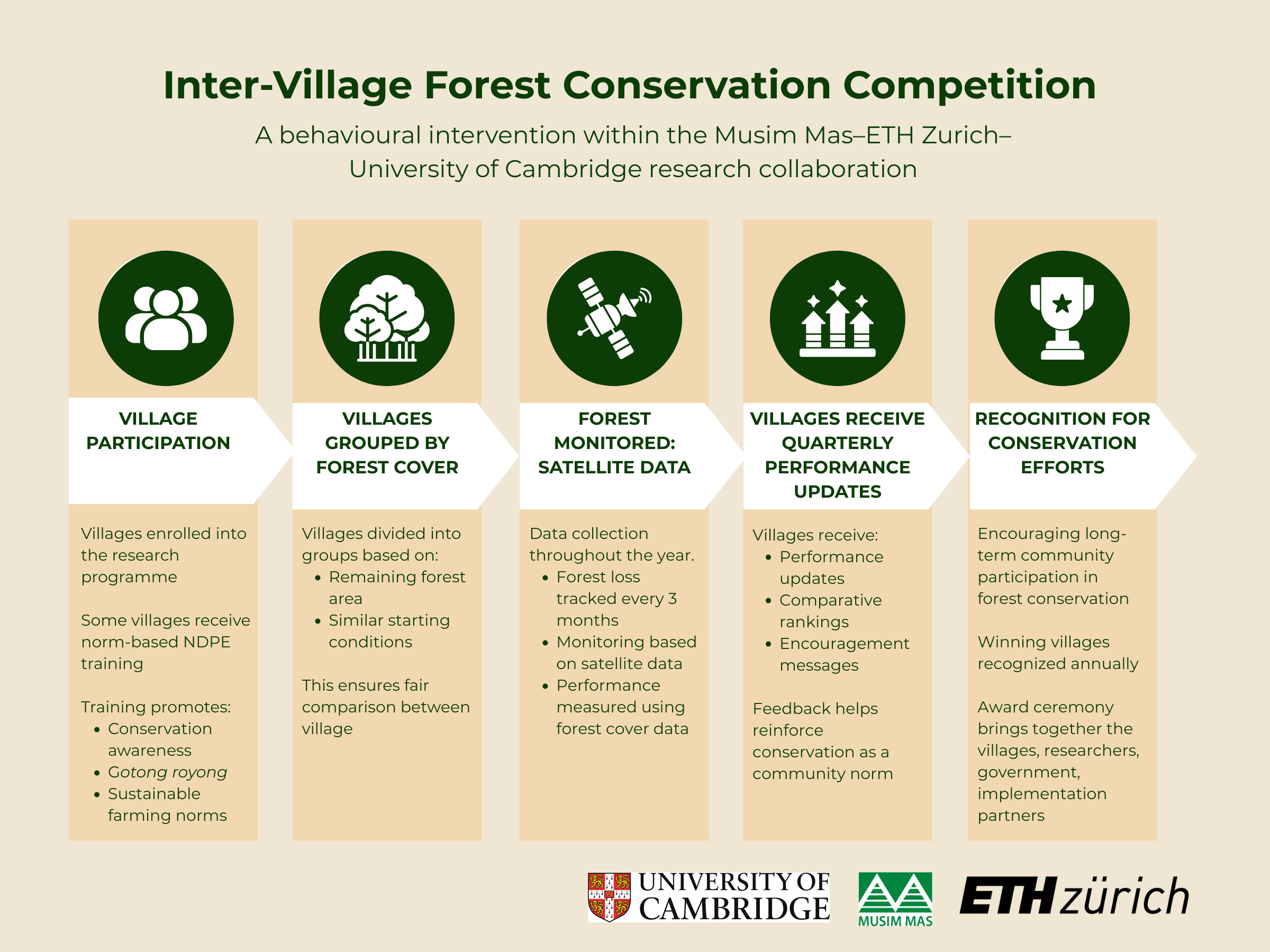
Alongside the training programme, participating villages take part in an annual inter-village competition.
The competition was designed as a behavioural intervention that provides villages with regular comparative feedback on forest conservation performance relative to their peers. Every three months, participating villages receive updates on their ranking through posters and WhatsApp messages.
Performance is assessed using satellite monitoring data that tracks forest loss in percentage terms. Villages are grouped according to the amount of remaining forest cover at the start of each year, allowing villages with similar forest conditions to compete against one another. This grouping mechanism was introduced to improve fairness and comparability across villages with different historical land-use patterns.
Dr. Joss Lyons-White, Research Associate at the University of Cambridge who manages the study’s implementation, said, “The norm-based approach represents a new approach to supply chain sustainability. Alongside the ‘norm-based’ training being delivered by Musim Mas, the inter-village competition encourages farmers to work together to achieve conservation goals by introducing a fun, competitive aspect to environmental protection. By providing regular feedback on how well villages are conserving forests compared to their peers, we expect the competition will help sustainable farming practices to become seen as the norm, leading to shifts in behaviour that last over the long-term.”
Rather than ranking villages quantitatively, villages receive qualitative feedback based on their relative performance within their competition group. Researchers intentionally avoided explicitly ranking villages to ensure the competition remained constructive and encouraging rather than punitive.
Designing Fairness into the Competition
Ensuring methodological fairness has been a key consideration in the competition’s design.
One challenge identified by the research team was that villages differ significantly in the amount of forest remaining within their boundaries. Villages with limited forest cover may experience relatively small absolute forest losses that appear proportionally large, while villages with extensive forest cover may show lower proportional losses despite larger areas affected.
To address this, participating villages are divided into “high forest cover” and “low forest cover” groups before rankings are calculated. This enables villages to compete against peers facing more similar starting conditions.
Researchers also accounted for differences in the timing of participation. Some villages entered the programme earlier than others depending on when they received NDPE training. To maintain comparability, all villages are allowed to participate for at least one full year, while performance is assessed using quarterly deforestation rates rather than total cumulative forest loss. These adjustments aim to ensure that comparisons between villages remain as equitable and scientifically robust as possible.
Expanding Participation Across the Landscape
The project has continued to expand since implementation began. To date, 64 villages have enrolled in the study, with 27 villages having received the norm-based NDPE training and currently participating in the inter-village competition. In 2025, 13 villages took part in the competition. That number increased to 22 participating villages in 2026.
The competition award ceremony for the 2025 cycle was held in Aceh Singkil and brought together village representatives, government agencies, Musim Mas teams, implementation partners, and researchers from the University of Cambridge and ETH Zurich.
Winning villages received certificates, commemorative plaques, and equipment for collective community use, while all participating villages continue receiving quarterly feedback and encouragement messages throughout the competition period.
Importantly, the study remains ongoing until 2027, and researchers emphasise that it is still too early to draw conclusions regarding long-term outcomes or effectiveness.
Instead, the current phase of the project is focused on continued implementation, monitoring, and data collection to better understand how behavioural interventions interact with local social dynamics, forest conditions, and community participation over time.
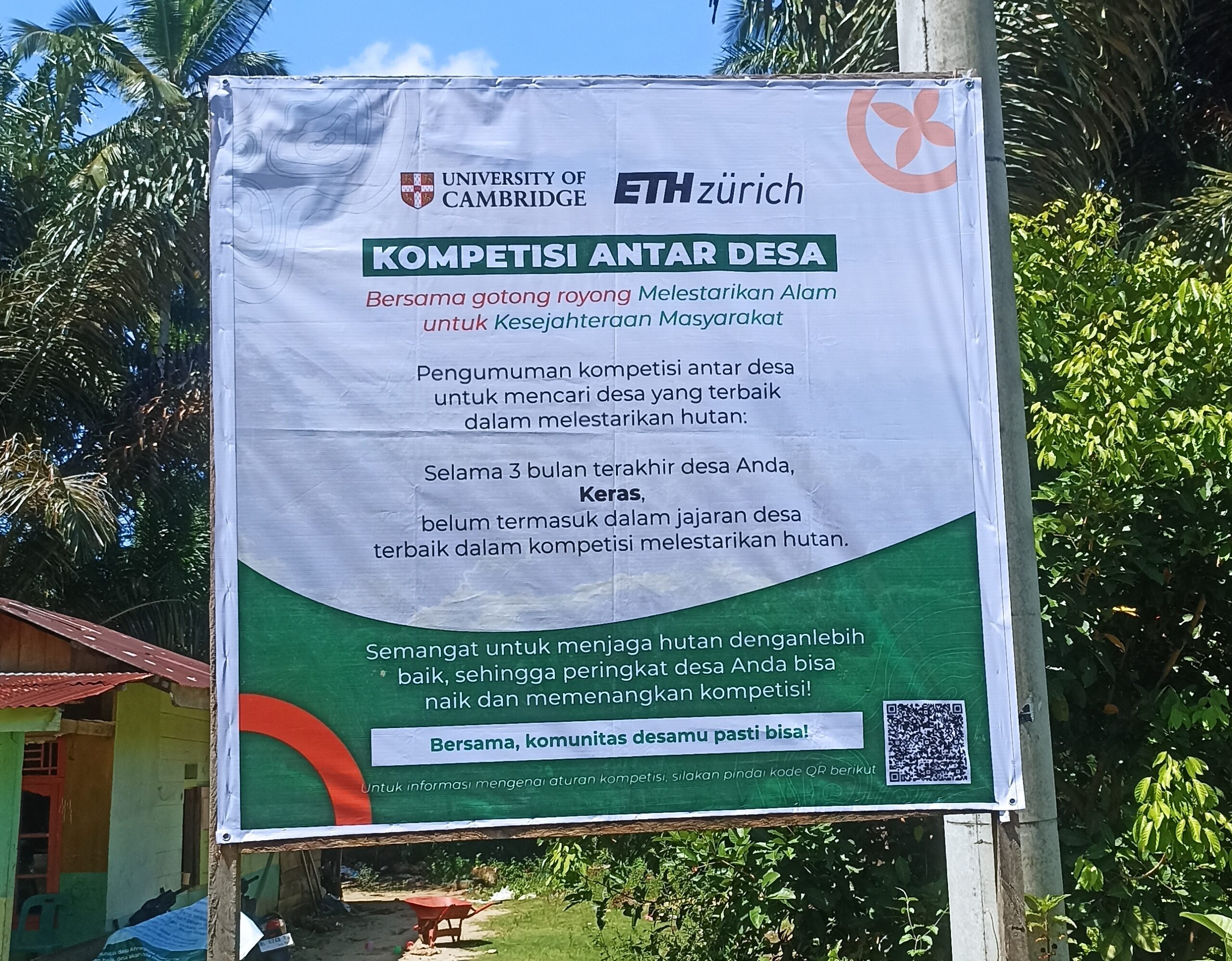
The quarterly Inter Village Competition update poster for selected villages
Building an Evidence Base for Sustainable Landscapes
The collaboration reflects a broader shift toward evidence-based approaches in landscape sustainability initiatives.
For Musim Mas, the project represents an opportunity not only to support implementation on the ground, but also to contribute to a deeper understanding of how sustainability interventions function in practice within smallholder landscapes.
As sustainability expectations continue evolving across global supply chains, the ability to rigorously evaluate which approaches are effective — and under what conditions — may become increasingly important for both industry and policymakers.
By combining field implementation with behavioural science and long-term empirical research, the project aims to contribute new insights into how conservation and smallholder inclusion can be pursued together within palm oil-producing landscapes.