By: Devane Sharma
Index
- What Are the Main Food Safety Risks in Palm Oil Processing?
- How Do Hygiene and Sanitation Programs Support Food Safety?
- How Is Contamination Prevented During Palm Oil Processing?
- How Do Testing and Monitoring Verify Food Safety Controls?
- What Happens When Food Safety Test Results Do Not Meet Specifications?
- How Are Raw Materials and Suppliers Managed for Food Safety?
- What Food Safety Certifications Are Common in the Palm Oil Industry?
- How Does a Systems-Based Approach Strengthen Food Safety Outcomes?
What Does Food Safety Mean in the Palm Oil Industry?
Food safety in the palm oil industry refers to the systematic control of biological, chemical, and physical hazards to ensure that palm-based food ingredients are safe for their intended use. Because palm oil and its derivatives pass through multiple stages of processing — milling, refining, storage, transport, and packaging — food safety depends on integrated controls rather than single-point testing.
International frameworks such as the Codex Alimentarius food safety framework define food safety as the assurance that food will not cause harm when consumed according to its intended use.
What Are the Main Food Safety Risks in Palm Oil Processing?
As with any form of food processing, food safety risks in palm oil are generally chemical, physical, or microbiological. Palm oil is not considered microbiologically sensitive due to its low water activity and high processing temperatures. However, contamination risks may arise from processing aids, machinery, packaging materials, and transport conditions if not properly controlled.
Key concerns include process contaminants such as 3-MCPD esters and glycidyl esters, mineral oil contamination in food, including MOSH and MOAH, and environmental contaminants such as polycyclic aromatic hydrocarbons (PAHs) and heavy metals.
How Do Hygiene and Sanitation Programmes Support Food Safety?
Hygiene and sanitation programmes establish the baseline conditions needed to prevent contamination during palm oil refining. Musim Mas’ refineries implement structured prerequisite programmes that define cleaning responsibilities, frequencies, and verification activities.
Processing and packaging take place in enclosed, controlled environments designed to minimise exposure to physical, chemical, and environmental contaminants. Packaging operations are conducted in designated Good Manufacturing Processes (GMP)-controlled rooms, where access is restricted to trained personnel wearing appropriate GMP attire. Strict material management practices are applied to prevent the accumulation of debris and foreign matter, and production areas are organised to support orderly material flow and segregation.
Environmental zoning and sampling programmes are used to map refinery areas according to risk, with routine monitoring conducted to verify that hygiene conditions remain under control. Cleaning activities in these areas follow defined daily and weekly schedules under formal housekeeping programmes, with verification carried out on a regular basis by plant management. Together, these measures ensure that packaging and exposure-prone areas remain clean, controlled, and suitable for food-grade production.
These controls align with the requirements of FSSC 22000, which emphasises controlled production environments, defined prerequisite programmes, environmental monitoring, and documented verification to ensure effective food safety management.
How Is Contamination Prevented During Palm Oil Processing?
Contamination prevention during processing relies on operational controls rather than end-product testing alone. Our refineries apply operational prerequisite programmes that focus on equipment design, process filtration, and material selection.
Musim Mas uses food-grade lubricants are used on machinery that comes into contact with food products, and engineering controls such as oil mist filters reduce the risk of incidental contamination from compressed air systems.
How Are Pest, Air, Water, and Waste Risks Managed in Refineries?
Refineries manage environmental risks through integrated facility management systems. Pest control programmes are implemented to prevent infestation, while enclosed buildings and controlled access reduce exposure to external contaminants.
Air and water used in production are managed under strict quality standards, and waste is handled in a way that prevents cross-contamination with food processing areas. These controls align with international food safety management standards such as ISO 22000 and FSSC 22000.
How Do We Test and Monitor to Verify Food Safety Controls?
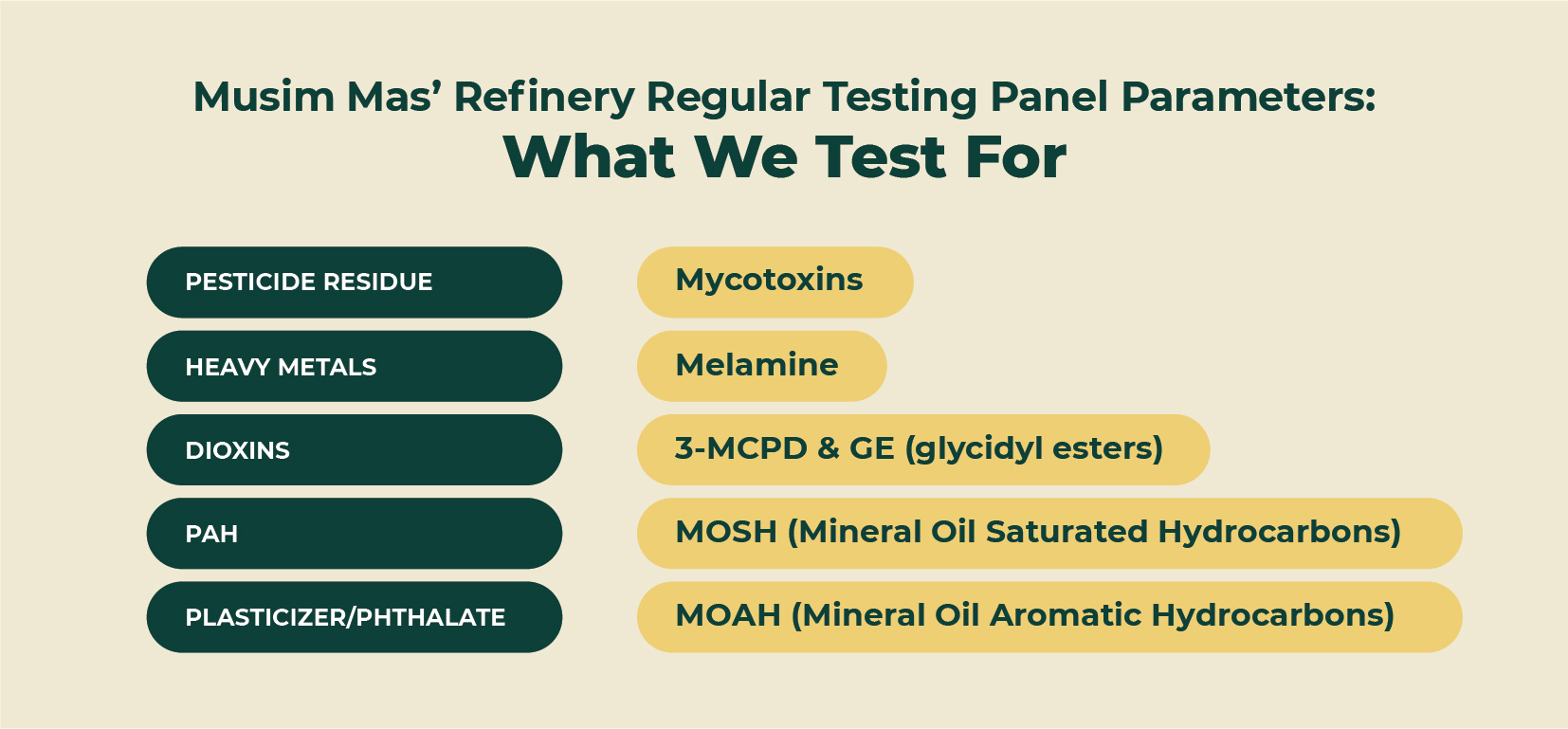
Musim Mas conducts testing and monitoring to verify that preventive controls function as intended, using both internal and external laboratories. We implement risk-based testing programmes covering both raw materials and finished products.
Critical parameters, such as 3-MCPD esters, glycidyl esters, and MOSH/MOAH, are monitored routinely, while broader screening for environmental contaminants is conducted periodically. Testing strategies reflect scientific guidance from authorities such as the European Food Safety Authority.
Musim Mas’ Refinery Regular Testing Panel Parameters: What We Test For
What Happens When Food Safety Test Results Do Not Meet Specifications?
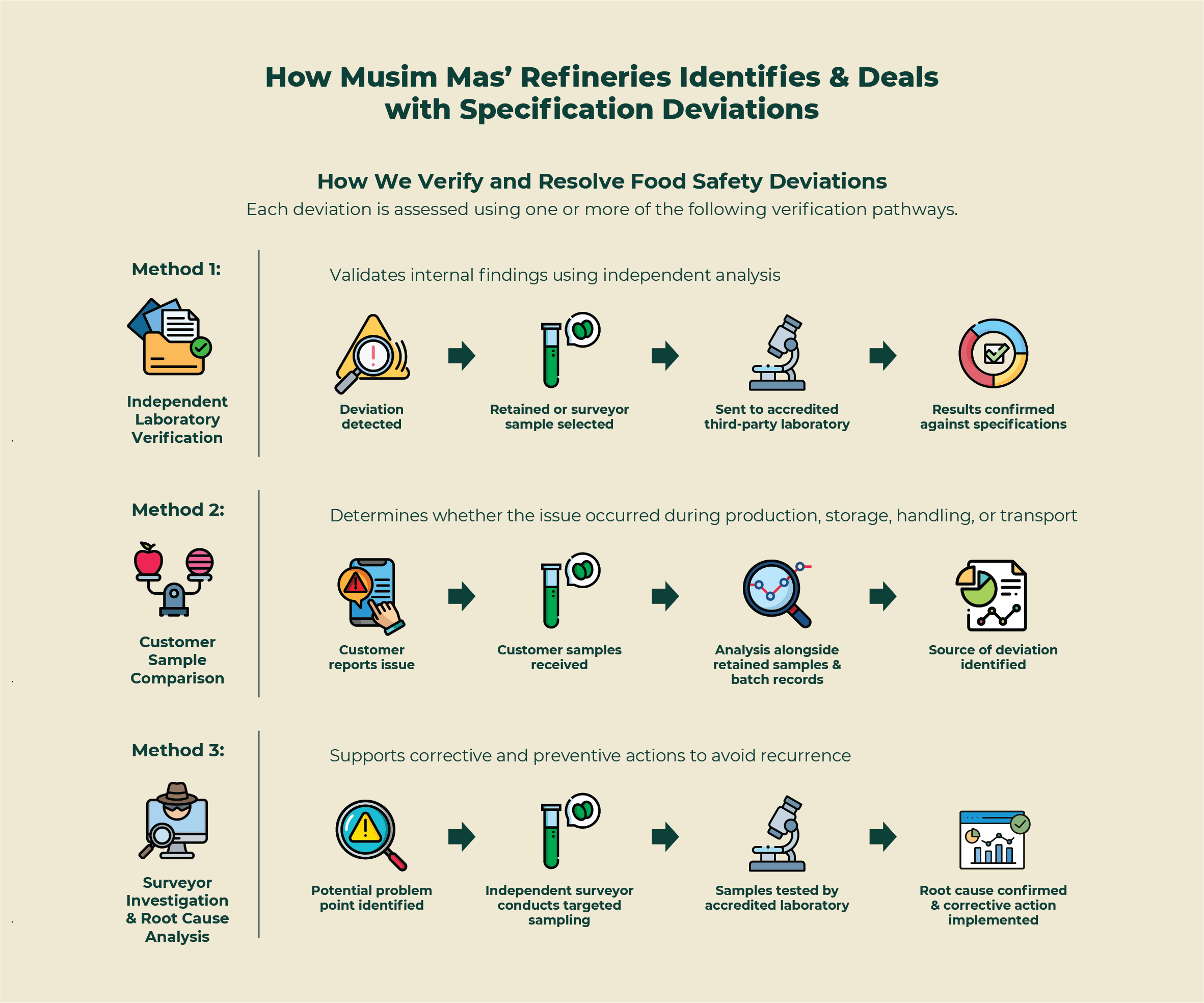
When test results fall outside agreed specifications, we activate our structured deviation management procedures. These include confirmatory testing by accredited third-party laboratories, comparison with retained samples or customer-provided samples, and independent verification where required.
Root cause analysis is conducted to determine whether deviations originate from production, storage, handling, or transport, followed by corrective and preventive actions to prevent recurrence.
How Musim Mas’ Refineries Identifies & Deals with Specification Deviations
How Are Raw Materials and Suppliers Managed for Food Safety?
Musim Mas’ food safety controls begin with supplier qualification and raw material approval. Crude palm oil, palm kernel oil, and additives must comply with contractual quality requirements and applicable food safety regulations.
We inspect incoming materials and conduct sample tested before processing. Transport containers undergo regular inspections, and tanks undergo cleanliness checks, cargo history reviews, cleanliness certificates, and on-site inspections to ensure suitability before loading.
How Does Traceability Work in the Palm Oil Refining Process?
Traceability systems allow each batch of refined palm oil to be linked to specific processing dates, plants, tanks, and raw materials. We make use of unique lot numbering to track the flow through production, storage, and shipment.
These systems support compliance with regulatory requirements such as the EU General Food Law and enable rapid response if a food safety issue arises. For certified supply chains, platforms such as RSPO PRISMA provide additional shipment-level traceability.
What Food Safety Certifications Are Common in the Palm Oil Industry?
Musim Mas’ palm oil refineries operate under internationally recognised food safety and quality management systems. These include FSSC 22000 for food safety management, ISO 9001 for quality management, and ISO/IEC 17025 for laboratory competence.
Additional certifications we support include Halal, Kosher, RSPO, and ISCC. They enable us to meet the needs of our customers, and meet leading traceability, and governance standards.
How Does a Systems-Based Approach Strengthen Food Safety Outcomes?
Food safety culture ensures that systems and procedures are applied consistently in daily operations. Musim Mas regularly trains our staff in Good Manufacturing Practices and food safety requirements to help employees understand their responsibilities and reinforces preventive behaviours.
Ongoing engagement with regulators and industry associations allows companies to stay informed about emerging risks and regulatory developments, supporting continuous improvement in food safety performance.
A systems-based approach integrates hygiene, process controls, testing, traceability, and certification into a cohesive framework. Rather than relying on final product testing alone, Musim Mas’ approach focuses on preventing risks at every stage of production.
As food safety expectations continue to evolve, integrated management systems help palm oil producers deliver safe, compliant products while maintaining transparency and trust across global markets.