A diagnostic report on mill verifications conducted in Central Kalimantan aims to provide a clear roadmap on what it means to achieve sustainability transformation in concrete terms. The report provides input that helps us develop a strategic approach to address issues raised at the landscape level. Read the full report here.
West Kalimantan contributes to 5% of our supply base and is one of the six provinces that contribute 80% of our supply base. We can trace up to 88% of plantations within the province, representing the highest percentage among the six provinces. The Sambas landscape covers an area of around 6,717 km2 which consists of production forest, protected forest, conservation forest, peatland, and village areas.
Following our Landscape Strategy for Aceh published in 2020, we have applied the lessons learned to guide our next steps.
Building on this progress, Musim Mas expanded its landscape approach in September 2024 to include Aceh, Riau, North Sumatra, South Sumatra, Central Kalimantan, and West Kalimantan under Musim Mas’ Priority Landscapes Strategy 2024
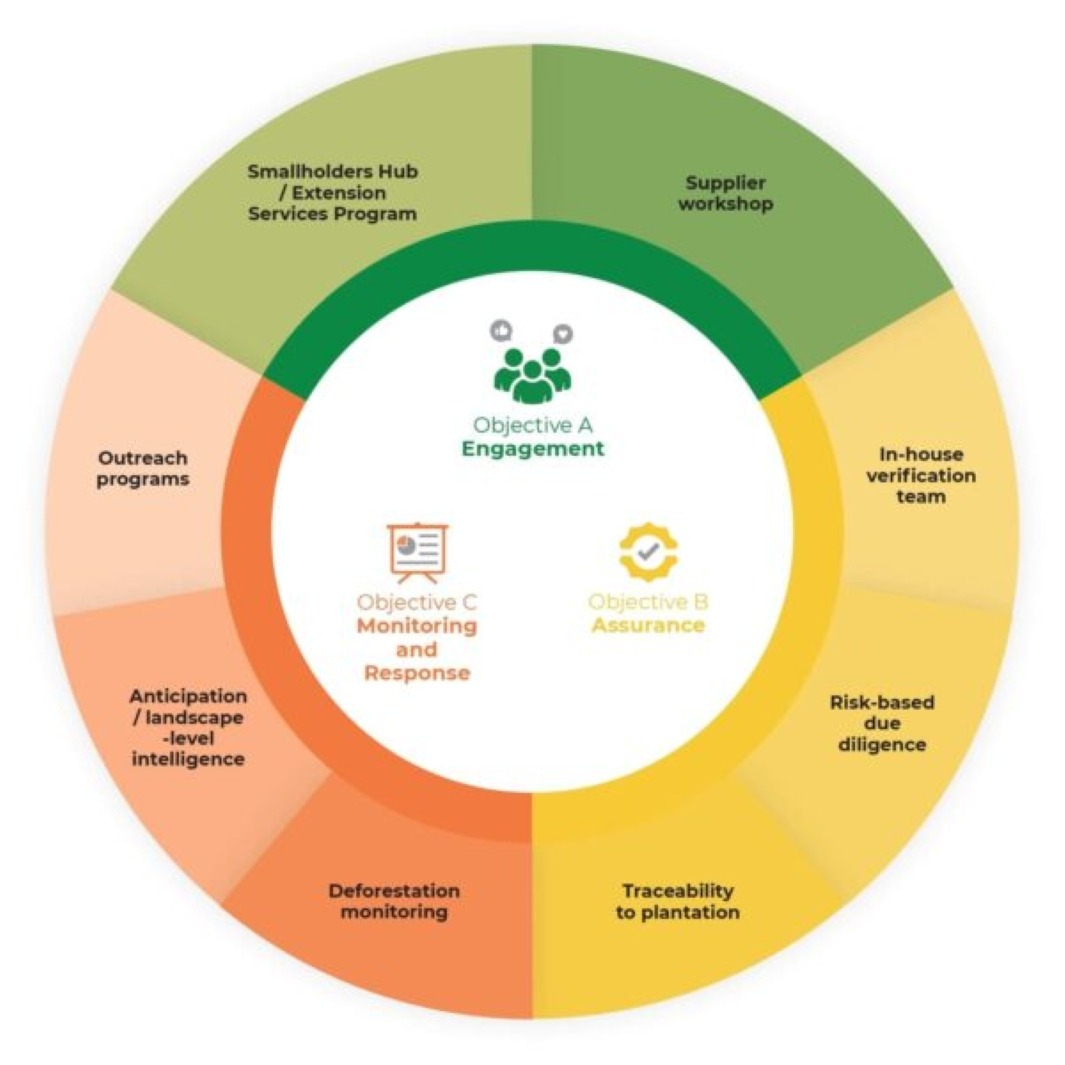
The landscape strategy comprises three objectives: Engagement, Assurance, and Monitoring and Response. This will fulfill a key component of the Group’s updated NDPE Roadmap to 2025, which commits to developing landscape strategies for all the Group’s remaining key sourcing regions.
Firstly, the Engagement objective entails outreach to independent smallholders and mills to convey NDPE requirements and the possible consequences of non-compliance.
The Assurance objective has components to ensure that the mills supplying crude palm oil and palm kernels to Musim Mas are NDPE compliant.
Finally, the Monitoring and Response objective contains proactive elements to detect and verify deforestation at the landscape or jurisdictional level.
 |
We collaborate with the government of Sambas on landscape initiatives to support smallholders in sustainable production.
|
We are working with Earthqualizer (previously Aidenvironment) to explore the Sambas conservation project potentially in the areas of agroforestry. This activity aims to facilitate two villages in Sambas Regency to apply for legalisation of forest area management through social forestry schemes, namely Madak Village in Subah District and Temajuk Village in Paloh District.
|
Assisting six selected villages in the Sambas and Aceh Singkil Regency in developing land-use plans via a participatory planning approach and helping with the planning and drafting village policies. This is done through the preparation of spatial plans and land-use documents with assistance and facilitation from the village government.


