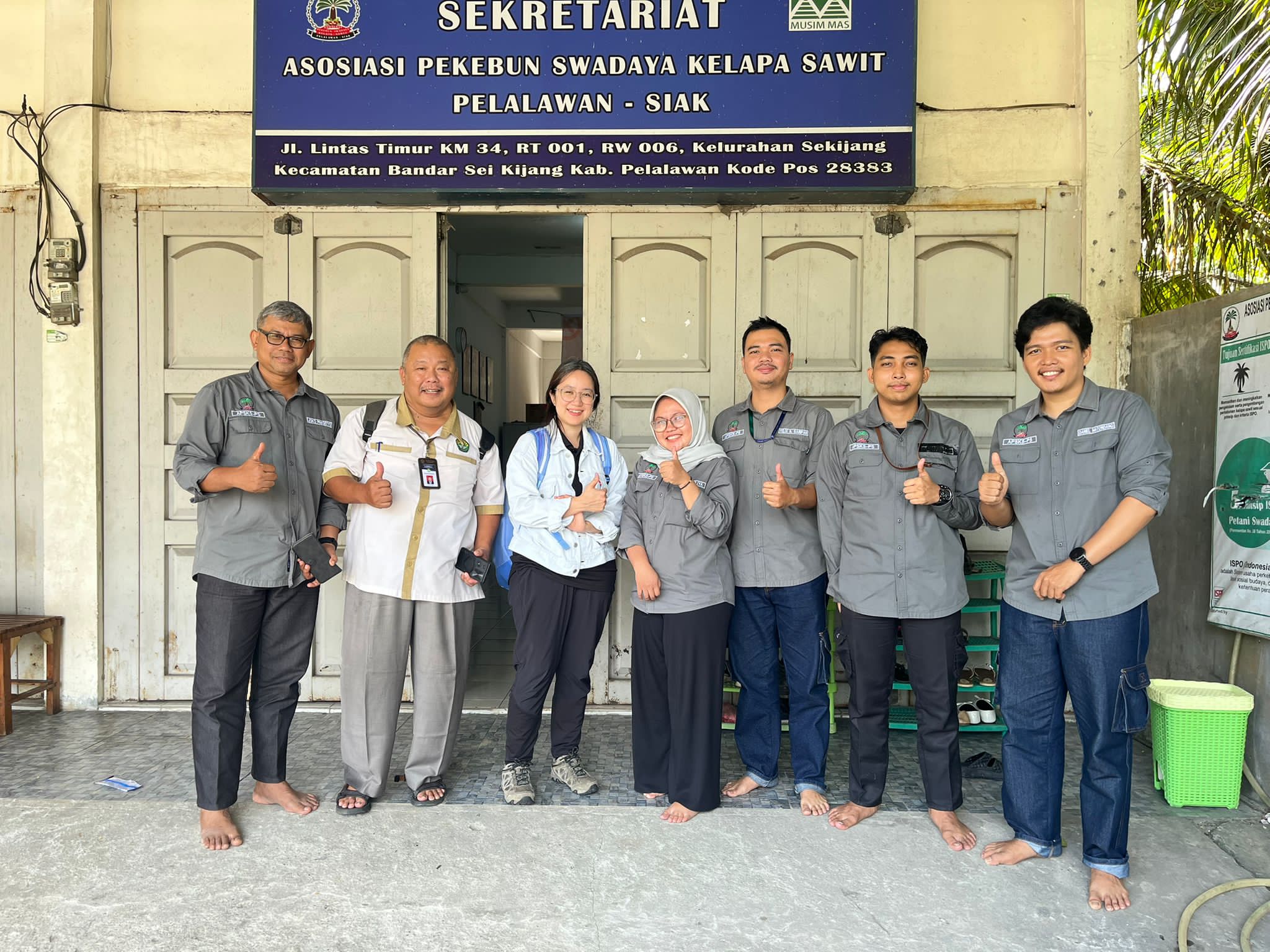
Associate Professor Janice Lee, NTU, with representatives from a farmers’ association in Pelalawan-Siak
A multi-year collaboration to study what motivates smallholder farmers to adopt sustainable palm oil practices, and how such behaviours can spread across farming communities in Indonesia.
9 February 2026, Singapore — Musim Mas Group and scientists from Nanyang Technological University, Singapore (NTU Singapore) have embarked on a multi-year research collaboration to understand what motivates independent smallholder farmers to adopt sustainable palm oil practices — and how these behaviours can spread within farming communities.
Led by Associate Professor Janice Ser Huay Lee from the Asian School of the Environment, NTU Singapore, the research will focus on independent smallholders in Riau Province, Indonesia, including those within and outside the Asosiasi Perkebun Swadaya Kelapa Sawit Pelalawan Siak (APSKS-PS), a Musim Mas–supported smallholder association. The study will explore the behavioural, social, and spatial factors that shape how sustainable practices are learned, shared, and adopted.
While the palm oil industry has made progress in promoting sustainability among smallholders, adoption rates remain uneven. Training programs alone often fail to translate into lasting behavioural change. Factors such as trust, peer networks, perceived benefits, and access to reliable information play crucial roles in influencing farmers’ decisions. To scale sustainability effectively, the sector must understand how and why farmers choose to change their practices.
The NTU researchers will combine spatial analysis, social network mapping, and large-scale farmer surveys to study smallholder communities. The project aims to identify the factors that best predict the spread of sustainable behaviours, offering evidence-based insights to guide companies and policymakers in promoting sustainability among independent smallholders.
Musim Mas runs Indonesia’s largest independent smallholder program, having trained over 40,000 farmers since 2015. The Group has made smallholder training a cornerstone of its sustainability efforts—even though independent smallholders do not directly supply to the company—recognizing that helping farmers plant and replant sustainably is key to the long-term health of the palm oil industry.
This collaboration supports Musim Mas’s commitment to science-based sustainability and builds on partnerships with leading research institutions such as ETH Zurich, the University of Cambridge, and IPB University.
“For sustainability to take root, we need to understand what truly motivates farmers to change—and how those changes spread through communities,” said Rob Nicholls, General Manager of Programs and Projects at Musim Mas. “This collaboration with NTU scientists will help us move from teaching sustainability to understanding it, so that our programs can be more effective, inclusive, and self-sustaining.”
Musim Mas will facilitate field access and data collection for the study, which will be independently led by the NTU team.
The collaboration aligns with ASE’s strengths in interdisciplinary environmental research, particularly its focus on the social dimensions of sustainability in Southeast Asia.
“Independent smallholders play a vital role in the palm oil landscape, yet their decision-making and social networks are often overlooked,” said NTU Associate Professor Janice Ser Huay Lee, Asian School of the Environment. “Through this partnership, we hope to uncover how knowledge, trust, and influence shape the adoption of sustainable palm oil practices—insights that can help design more effective and equitable interventions across the region.”
The project runs for about 2 years and 9 months from June 2025 and ends on March 2028, with field visits to the districts of Pelalawan and Siak, Riau. NTU works collaboratively with three other Indonesian universities, including North Sumatra University, IPB-University and The University of Riau. The findings will inform future smallholder program design and engagement strategies, with potential applications beyond palm oil to other smallholder-based agricultural sectors in Southeast Asia.
About Musim Mas
Musim Mas Group is an integrated palm oil company operating in 13 countries. From plantations to mills, refineries, kernel-crushing plants, oleochemicals, and specialty fats plants, Musim Mas manufactures palm oil products and value-added derivatives. Musim Mas is one of the largest domestic producers and exporters in Indonesia. Inter-Continental Oils and Fats (ICOF), a member of Musim Mas Group, undertakes global marketing activities.
The Group is committed to sustainability and was the first company with significant operations in Indonesia to join the Roundtable on Sustainable Palm Oil (RSPO) in 2004. Committed early to emissions reductions, Musim Mas is a signatory to the Agriculture Sector Roadmap to 1.5 Degrees convened by the Tropical Forest Alliance. The Roadmap aims to halt commodity-linked deforestation in line with the 1.5-Degrees pathway while enhancing the livelihoods of smallholder farmers and supporting the sector’s transformation toward forest-positive land-use management. In January 2024, Musim Mas announced that it will strive to achieve net zero by 2050, aligning with climate science as per the Science Based Targets Initiative (SBTi). Musim Mas also manages the most extensive independent smallholder programs in Indonesia.
About Nanyang Technological University
The Nanyang Technological University, Singapore (NTU Singapore) is a research-intensive public university and has 35,000 undergraduate and postgraduate students in the Business, Computing & Data Science, Engineering, Humanities, Arts & Social Sciences, Medicine, Science, and Graduate colleges.
The Asian School of the Environment (ASE) at NTU Singapore is a diverse school focusing on the connections between geosciences, ecology, society and Earth systems. ASE integrates these disciplines to examine big environmental challenges both in Southeast Asia and globally. ASE conducts cutting-edge research on topics that include ecology, geohazards, climate change, sea-level rise, environmental sustainability, conservation of environment and biodiversity, and interactions between environment and society.