By: Devane Sharma
Why Agroforestry Matters Now | What Is Agroforestry? | Why Agroforestry Is Important | The Five Agroforestry Models in the BIPOSC Project | Supporting the Transition: Training and Demonstration Plots | The Agroforestry Nursery: Growing the Seeds of Change | Looking Ahead: Building Climate-Resilient Landscapes
In North Sumatra’s Labuhanbatu District, hundreds of smallholder palm oil farmers are reimagining how their land can work for them — and for nature. As part of the Biodiverse & Inclusive Palm Oil Supply Chain (BIPOSC) Project, a 10-year partnership between Musim Mas, the Livelihoods Fund for Family Farming (L3F), SNV and other partners, farmers are learning how to build healthier soils, protect biodiversity, and make their farms more resilient.
After three years of introducing regenerative agriculture practices that focus on restoring soil health and reducing chemical dependency, the project is now moving toward its next phase — agroforestry. This approach helps farmers who apply regenerative agriculture principles go beyond sustainability by integrating trees, crops, and sometimes livestock to create productive and ecologically balanced farms.
In collaboration with SNV Indonesia and a network of farmer champions, the project is training smallholders on how to adopt agroforestry models suited to their land. Over 935 farmers have been trained in agroforestry, and 20 hectares of agroforestry demonstration plots have been established to help farmers learn hands-on and see real results for themselves. The participating farmers are part of a local farmers’ association.
Why Agroforestry Matters Now
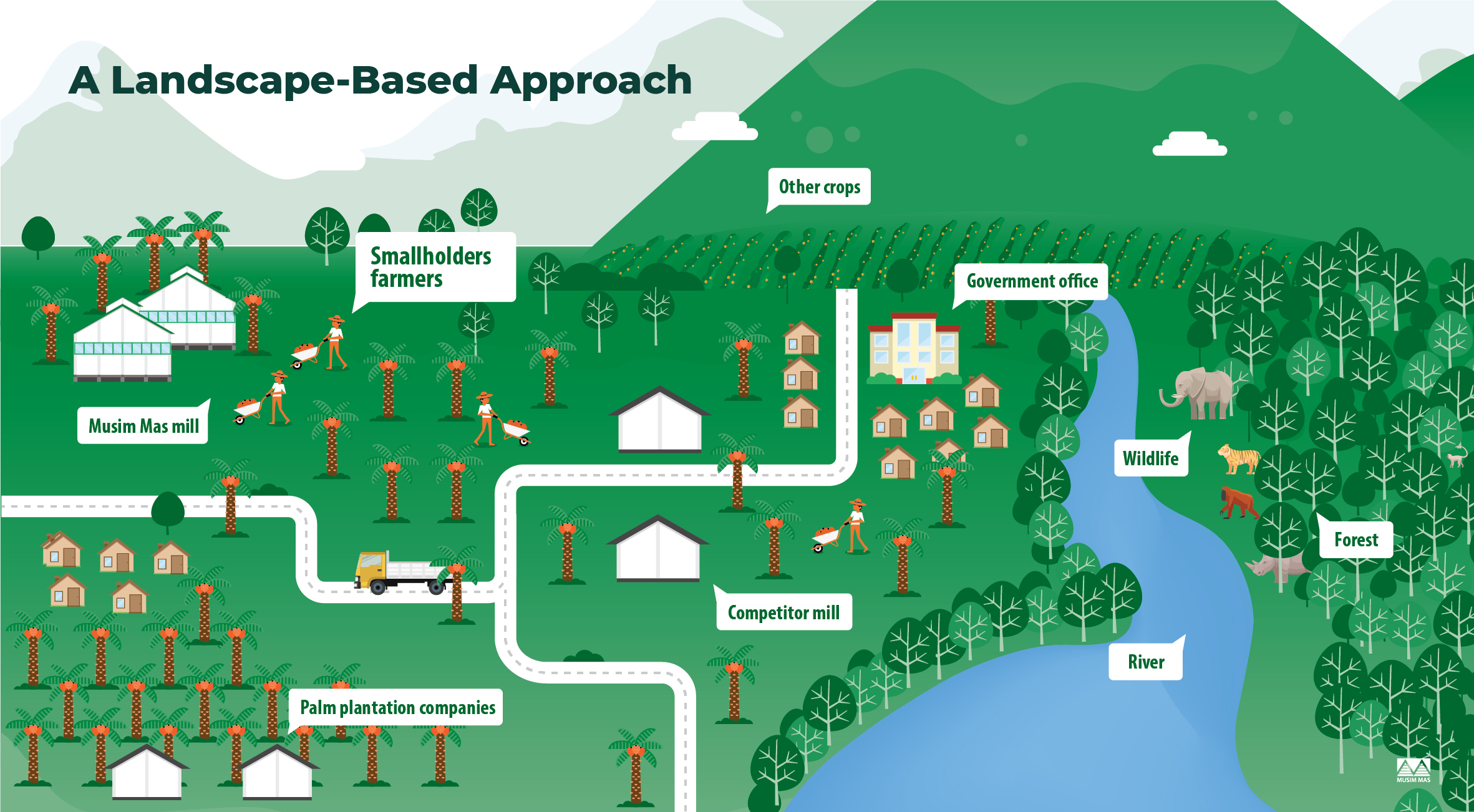
Agroforestry is still relatively new in the context of palm oil, but its relevance can be seen. In recent years, Sumatra has faced floods and landslides including a major flooding incident in early December 2025. Deforestation, soil degradation, and poor landscape management may have contributed to it. As one of the largest players in sustainable palm oil, Musim Mas recognizes the need for land-use models that rehabilitate ecosystems while supporting farmer livelihoods. Some of its potential benefits include:
- Strengthening riverbanks near palm oil plantations, offering a transitional restoration approach.
- It creates buffer zones between palm plantations and forests, supporting biodiversity and reducing ecological pressure on forest edges.
- Agroforestry aligns with increasing demands for nature-positive supply chains, ensuring long-term viability for farmers and buyers.
By adopting agroforestry, smallholders can play a direct role in preventing erosion, restoring biodiversity, improving soil structure, and creating more climate-resilient landscapes.
What Is Agroforestry?
Agroforestry is an approach to land management where trees or shrubs are grown around or among crops and pastureland. It’s based on the idea that combining different species and components of the ecosystem — such as trees, crops, and livestock — creates mutually beneficial relationships.
Rather than treating each element of the farm as separate, agroforestry integrates them to build a more sustainable and productive land-use system. Trees help enriching the soil, prevent erosion, and regulate water cycles, while farmers gain from diversified yields, better soil fertility, and improved climate resilience.
Agroforestry is a natural extension of regenerative agriculture. While regenerative agriculture rebuilds soil health and restores balance to the land, agroforestry adds a new layer of resilience — diversity. In essence, agroforestry works with nature instead of against it — creating landscapes that are productive, biodiverse, and sustainable.
Why Agroforestry Is Important

Environmental protection
Agroforestry offers tangible benefits that go far beyond improving yields. Environmentally, it helps rebuild the natural balance of the land. Trees absorb carbon dioxide from the atmosphere, storing it in their trunks, roots, and surrounding soil — effectively reducing greenhouse gas emissions from agriculture. Their roots stabilize the ground, prevent erosion, and enhance the soil’s ability to retain water, while the organic matter they contribute restores soil fertility over time. The diversity of plant species also attracts birds, pollinators, and beneficial insects, creating habitats that enrich biodiversity and strengthen ecosystem resilience.
Economically, agroforestry empowers farmers to diversify their income. By integrating fruit trees, timber species, or livestock such as cattle into their palm plots, smallholders can generate multiple revenue streams throughout the year. The use of organic compost from livestock manure and decomposing plant matter also lowers dependence on chemical fertilizers. Over time, these practices make farms more productive, self-sustaining, and resilient to both market and climate fluctuations.
For many smallholders, agroforestry represents a path toward both economic stability and environmental stewardship — proof that farming sustainably can also mean farming profitably.

A clump of healthy soil found in the demonstration plot (left) compared to clay-like unhealthy soil in a surrounding area
Healthier Soil and Ecosystems
Trees planted alongside oil palms contribute enrich the soil with organic matter and nutrients while their roots help prevent erosion and improve water retention.
Improved Biodiversity
Agroforestry plots create habitats for birds, pollinators, and beneficial insects, strengthening ecosystem balance. For example, if fruit and timber trees are planted, they attract insect-eating and seed-dispersing birds which help control pests and support tree regeneration.
Climate Change Mitigation
Trees absorb carbon dioxide, helping offset emissions from agriculture. Beyond carbon storage, the trees provide shade that help reduce water evaporation from surrounding crops.
Resilient Livelihoods
Farmers can grow fruit, timber, or other high-value crops alongside palm oil — creating additional income sources that are less vulnerable to market or climate shocks. The goal is to create landscapes that are both productive and regenerative, leveraging the synergies between the natural components of the ecosystem.
The Five Agroforestry Models in the BIPOSC Project

The project introduces five distinct agroforestry models, allowing each farmer to select the most suitable option for their land, resources, and goals. Experts from SNV and farmer champions guide smallholders in choosing the best model based on soil conditions, land size, and crop health. Other factors such as if they have many gaps between their planted palms can also influence the model chosen.
Model 1: Palm Oil with Annual or Semi-Perennial Intercropping
This model integrates short-term crops — such as vegetables, legumes, or herbs — planted in rows between palm oil trees. It helps farmers make use of available space while improving soil health through diverse root systems. The fast-growing crops also provide additional income in between palm harvests.
“My farmland used to be dry, so the harvests were not really optimal. In the past, I used to manage my farm without really knowing how. But now (through the project’s support) I have learned proper fertilizing methods, how to care for the plants, and how to manage pests. Now, my income has increased by about 70 to 80 percent.” – Mujiono, an independent smallholder who participated in the program.

Mr Mujiono, an independent smallholder (Photo credit: SNV)
Model 2: Silvopastoralism (Palm Oil with Cattle and Fodder Crops)
In this model, green fodder plants are cultivated alongside cattle grazing areas under the palm trees. The cows provide manure that can be composted into organic fertilizer, reducing the farmers’ reliance on chemical inputs.
A farmer may choose to rear a cow where they could use its manure as compost for their palms. This would save on fertilizer costs, improve soil health and therefore make the land more productive in the long term.
Model 3: Palm Oil with Perennial Trees (Fruit, Nut, Timber) in Split Plots
Farmers allocate sections of their land for fruit or timber trees such as durian, mahogany, cocoa, and areca palm. These crops take longer to mature but can provide substantial returns in the long run, turning farms into a longer-term investment.
Model 4: “Sisipan” Agroforestry Patches on Palm Plots
Derived from the Indonesian word sisipan, meaning “to fill in,” this model involves planting crops in vacant spaces within palm plots. It’s particularly useful for farmers with empty patches caused by Ganoderma infection, a common disease that causes death for the plant.
Model 5: Palm Oil with Fruit and Timber Hedges
This model establishes rows of fruit or timber trees along the boundaries of palm plots. These hedges act as windbreaks, prevent erosion, and provide additional yields. They also contribute to biodiversity corridors across smallholder landscapes. This model is typically used for larger plots.
Supporting the Transition: Training and Demonstration Plots
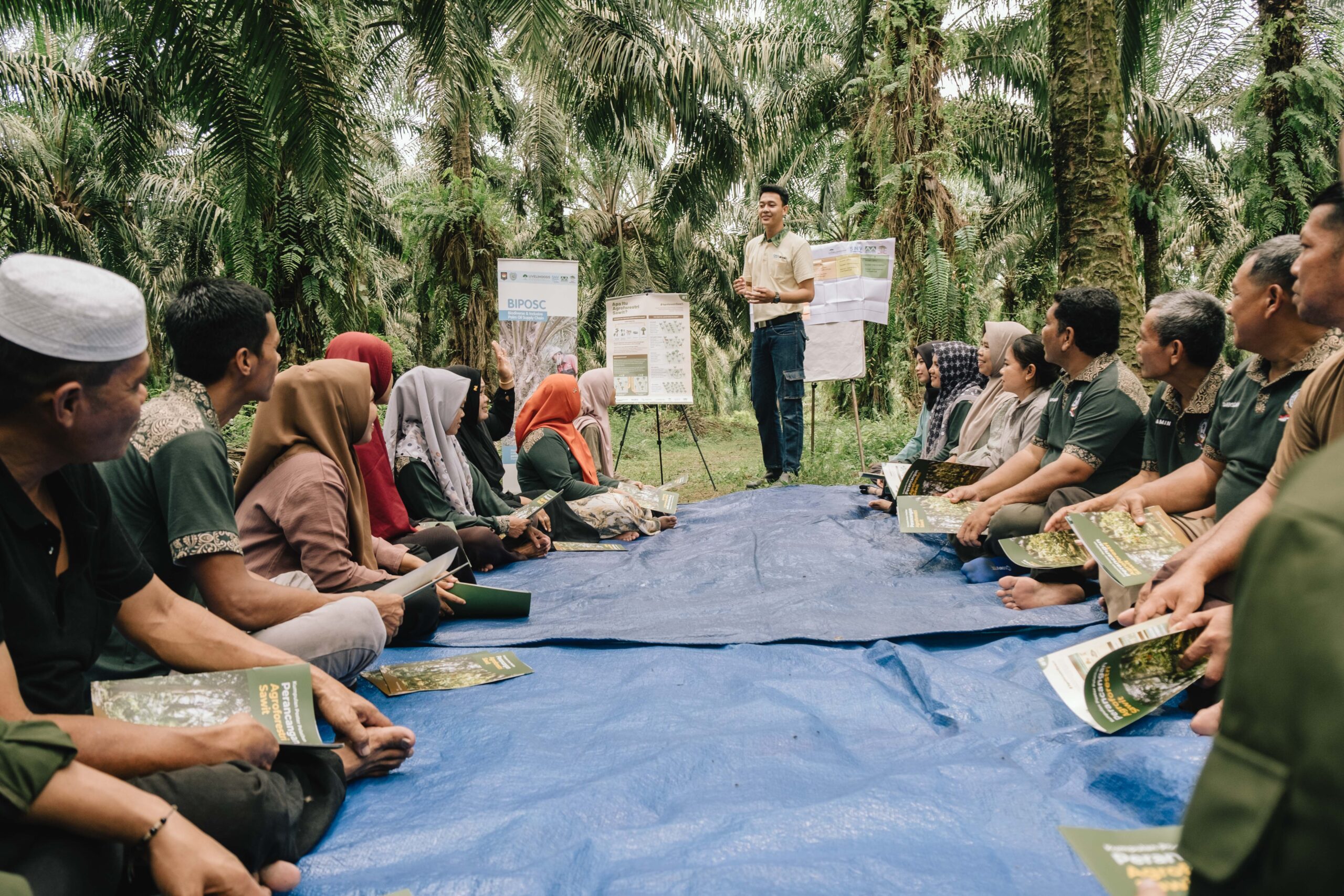
A farmer training session
In this project, all participating smallholders were first taught how to apply regenerative agriculture principles. Those who have been applying its principles correctly and consistently were recommended for training in agroforestry.
To ensure successful adoption, the project partners conduct capacity-building sessions for the smallholders that combine classroom learning with field practice. Farmers first receive theoretical training on agroforestry concepts — such as spacing, soil management, and species selection — followed by hands-on guidance in demonstration plots.
In these demo plots, farmers can observe real examples of the five agroforestry models and see how different combinations of crops and trees interact. Continuous monitoring and mentoring from SNV and farmer champions help ensure the practices are implemented correctly and adapted to the unique conditions of each smallholder’s plot.
The Agroforestry Nursery: Growing the Seeds of Change

A variety of relevant crops grown in the nursery
A key enabler of the project’s success is the agroforestry nursery, which supplies quality seedlings to smallholders. So far, the nursery has cultivated a wide variety of plants suitable for integration into palm plots, including durian, bitter beans, banana, cocoa, mahogany, and others.
Smallholders in the project area can request seedlings to implement the agroforestry model most suitable to their land. By providing access to diverse, high-quality plant seedlings, the nursery equips the smallholders with the tools to sustainably transform their farms.
Looking Ahead: Building Climate-Resilient Landscapes
Agroforestry in the BIPOSC isn’t a one-size-fits-all approach. Each farmer receives tailored advice from SNV Indonesia and trained farmer champions, who help assess which model fits their land best. Those already practicing regenerative agriculture are especially encouraged to adopt agroforestry as a next step — reinforcing soil health, boosting yields, and creating lasting value from their land.
As more farmers adopt these models, the benefits extend beyond individual plots. Collectively, these smallholder-led efforts contribute to healthier ecosystems, more resilient communities, and a truly sustainable palm oil supply chain.
For Musim Mas, L3F, SNV, and other partners, the BIPOSC Project is more than an initiative — it’s a shared commitment to redefining palm oil cultivation through resilient, replicable models. By working with local farmer associations and developing demonstration plots, nurseries, and training systems, the project partners hope BIPOSC will inspire local governments and smallholder groups to adopt sustainable farming practices such as regenerative agriculture and agroforestry.