By: Frances Lam
With its significant impact on Indonesia’s economy, the palm oil industry plays a crucial role in driving sustainable development. To meet global palm oil demand responsibly, continuous efforts are made to explore and implement sustainable solutions. The company has obtained RSPO Principles and Criteria certification across 15 management units. At Musim Mas, we reuse or recycle all non-hazardous waste generated from upstream processes, enabling our facilities to operate as 100% Circular-waste mills.
What you’ll learn:
- How do our palm oil mills operate under a “Circular Waste” principle?
- Driving Sustainability through Circular-Waste Mills Operations
- What are the benefits of Circular waste?
- What are the limitations of Circular-waste systems?
1. How do our palm oil mills operate under a “Circular Waste” principle?
Guided by our commitment at our palm mills, by-products are recycled into the process and converted into a harmless material that can be reused or used elsewhere.
The commitment starts with taking a closer look at the typical by-products that arise during palm oil processing. Understanding this concept begins with taking a closer look at the typical by-products that arise during palm oil processing.
When palm fruits are crushed and processed to produce Crude Palm Oil and Palm Kernel Oil, it produces four main by-products:
- Decanter solids
- Boiler ash
- Empty fruit bunches, fibers, and shells
- POME and methane
Among these by-products, methane poses a particular sustainability challenge. Over 20 years, its warming potential is about 80 times greater than that of carbon dioxide.
At Musim Mas, efforts to reduce methane emissions have been integrated into our sustainability strategy. Beyond this, all additional by-products are processed for recycling or repurposing to ensure that our mills achieve a complete Circular-waste operation.
2. Driving Sustainability through Circular-Waste Mills Operations
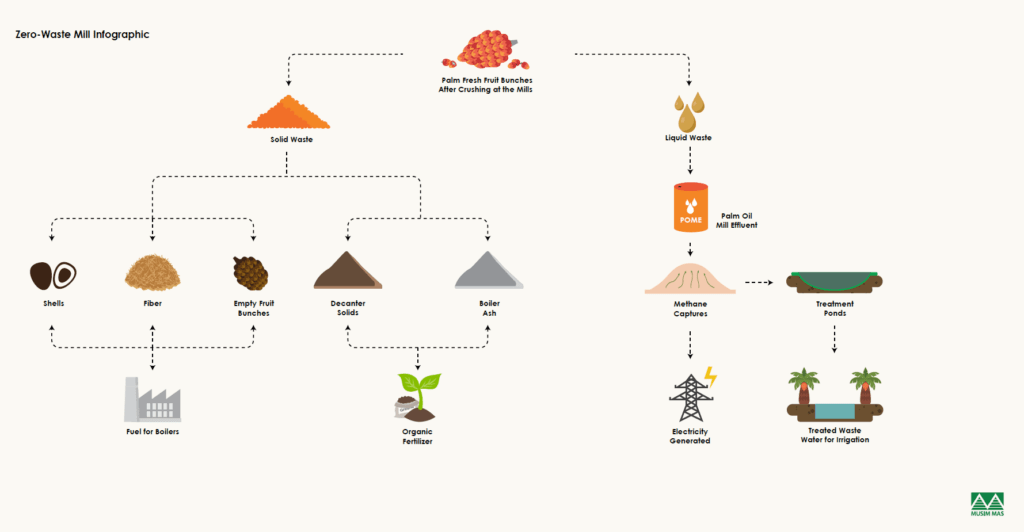
Over the past decade, Musim Mas has focused on developing innovative solutions to address the three main types of waste generated at palm oil mills: solid, liquid, and gaseous.
Through continuous research, technological upgrades, and circular-economy practices, the company has focused on transforming each waste stream into valuable resources rather than treating them as byproducts to be discarded.
Solid Waste Management
When mills process fresh fruit bunches, they generate empty fruit bunches, kernel shells, and fibre. Kernel shells and fibre dry easily and burn efficiently, so mills feed them into biomass boilers to produce heat and generate steam.
The steam powers turbines and drives machinery, supplying heat and electricity for mill operations. Mills can also use empty fruit bunches as biomass fuel after shredding or partially drying them, depending on the mill system.
Because these by-products are renewable, abundant, and produced onsite, they provide an efficient and sustainable alternative to fossil fuels. Mills readily use them to generate the heat and electricity required for operations.
Decanter Solid and Boiler Ash
Additional solid wastes, such as decanter solids and boiler ash, are produced at our mills as by-products of the decanter process.
Boiler ash is notably more challenging to process. Nevertheless, following years of research and operational improvements, its application back to the plantation has been made possible by Musim Mas.
The mill captures heat from boiler flue gas to dry boiler ash, turning it into an organic fertilizer that enhances soil quality and supports sustainability.
Liquid Waste Management
Palm Oil Mill Effluent (POME) is an oily wastewater generated during the processing of fresh fruit bunches (FFB) into crude palm oil. It contains suspended solids generated by various processing activities. Due to the organic matter discharged, liquid waste must be treated before release.
Alternatively, it may be captured and reused, for example, in biogas generation or nutrient recovery, which is carried out through anaerobic digestion in deep ponds, followed by treatment in facultative and algal lagoons.
This process reduces effluent toxicity levels but releases methane, a greenhouse gas with a global warming potential 29.8 times greater than carbon dioxide.
Through treatment in oxygenated aero-flow ponds, the system reduces the Biochemical Oxygen Demand (BOD) to below 100 ppm, allowing application to oil palm trees. Once fully treated, the effluent becomes suitable for irrigation.
Gas Emission
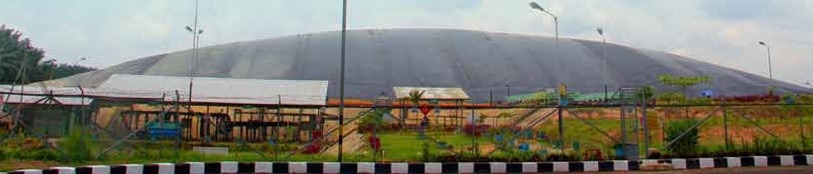
When Palm Oil Mill Effluent (POME) naturally breaks down, it releases gas, primarily methane. If left unmanaged, this methane can contribute to global warming.
At Musim Mas, this is an opportunity, as it is the first major Group in the palm oil industry to commit to extending methane capture projects to its mills. Recognized as a pioneer in methane capture in the palm oil industry, Musim Mas hosted the visit to showcase its methane capture technology at the palm oil mill.
President Director of PT Musim Mas, Gunawan Siregar, welcomed Minister of Environment for Indonesia, Mr. Hanif Faisol and his delegation during the site review.
In 2024, 17 methane capture facilities were commissioned by Musim Mas, fulfilling the target of equipping 17 mills with this technology. The total Group emissions savings attributable to methane capture in 2024 was estimated at approximately 490,885 MT CO₂e.
Our methane capture system prevents methane from being released into the atmosphere by sealing treatment lagoons with high-density polyethylene covers. The captured methane is then used as a renewable energy source to generate electricity for our mills, estates, and workers’ housing. In 2024, Musim Mas supplied approximately 33.8 million kilowatt-hours (kWh) of electricity, as reported in the Sustainability Report.
3. Benefits and Challenges
A Circular Waste approach in the palm oil industry helps turn waste into value by making full use of oil palm by-products. This reduces environmental impact, improves efficiency, and supports more sustainable operations. While the benefits are significant, adopting Circular Waste practices can also be challenging, requiring the right technology, investment, and coordination across operations. Let’s look at some of the benefits and challenges that may be faced.
What are the benefits of Circular waste?
1. Reduced Environmental Impacts
- Lesser waste sent to landfills or discharged into the environment
- Lower pollution of soil, water, and air pollution
2. Improved Resource Efficiency
- Maximum use of all by-products
- Reduced need for external inputs
3. Cost Savings Over Time
- Lower waste disposal costs
- Energy savings from using biomass and biogas use
- Reduced spending on synthetic fertilizers due to organic alternatives
4. Stronger Sustainability Credentials
- Supports certification standards (e.g., RSPO, ISCC)
- Builds trust with customers and stakeholders
What are the limitations of Circular-waste systems?
1. Operational Complexity
- Managing solid, liquid, and gaseous waste streams requires careful coordination
- Equipment and ponds need routine maintenance
- Continuous monitoring is necessary to maintain system stability and efficiency
2. Skilled Workforce Needed
- Expertise is required in waste management, microbiology, energy systems, and environmental compliance.
3. Regulatory Compliance
- Strict environmental standards must be met for effluent reuse, emissions, and fertilizer application.
Performance and Progress
The benefits of our Circular-waste mills are evident in the progress we have made. In 2024, our 17 methane capture facilities collectively avoided 490,885 MT of CO₂e emissions, underscoring the impact of effective methane management.
Our operations generated over 94% of upstream energy from renewable sources, and in 2024, our methane capture facilities exported 33.8 million kWh of surplus renewable electricity to the national grid.
The pursuit of Zero Waste remains a key pillar of our sustainability policy. Significant progress has been recorded, with several mills and plantations already operating at 100% zero-waste.
We actively support sustainable palm oil production and its derivatives across our vertically integrated operations.
Moving Toward a More Sustainable, Circular Waste Future
At Musim Mas are creating new possibilities for more sustainable, responsible palm oil production by moving toward Circular Waste. The progress we have achieved so far shows how we can create meaningful change by maximizing resources and reducing environmental impacts.
We continue to expand these efforts, shaping a more environmentally conscious supply chain that benefits both the industry and the communities it serves.
Watch our explainer video: