By: Frances Lam
Many people know the term “palm oil” but don’t really understand what it is or why it shows up in so many products. It is used around the world because it’s affordable to produce and work well in a wide range of things we use every day.
Palm oil sparks many important questions, making it a perfect starting point for a Palm Oil 101 overview: How is it grown? Why does it appear in so many everyday products? And what effects does its production have on the spanning biodiversity loss, severe environmental consequences, and the challenges faced by the communities whose livelihoods rely on palm oil cultivation.
What you’ll learn:
- What is Palm Oil and Where does it come from?
- In which regions are oil palms commonly found?
- What is the scientific name of palm oil?
- Under what growing conditions does Elaeis guineensis thrive in?
- How is palm oil cultivated?
- What are the different types of palm oil?
- Who consumes palm oil?
- How much palm oil is Indonesia producing in a year?
- What are the economics of palm oil supply and demand?
- How Much Palm Oil Do We Consume Worldwide?
- What are the main problems with palm oil production?
- What is sustainable palm oil?
- How do I know if a product uses sustainable palm oil?
- Should palm oil be completely avoided or boycotted?
- Can Palm Oil Really Be Sustainable?
- Why do companies still use palm oil?
- Is sustainable palm oil real or just greenwashing?
1. What is Palm Oil and Where does it come from?
Palm oil comes from the fruit of the oil palm tree, a crop known for producing more oil per hectare than most other oil-producing plants. It is the world’s most used vegetable oil and can be found in products like food, cosmetics, cleaning items, and even fuel.
2. In which regions are oil palms commonly found?
Oil palm trees grow in tropical regions, with Indonesia and Malaysia leading global production. They supply around 85% of the world’s palm oil. Other producing countries include Thailand, Nigeria, Colombia, and Papua New Guinea.
3. What is the scientific name of palm oil?
Producers mainly use the African oil palm (Elaeis guineensis) to make palm oil, and they grow it widely in Indonesia and Malaysia. Another species, Elaeis oleifera, grows mainly in Central and South America, but producers use it far less often for large-scale production.
4. Under what growing conditions does Elaeis guineensis thrive in?
Producing the most oil per hectare among commercial crops, Elaeis guineensis fits perfectly in Southeast Asia’s humid, rainy, tropical climate, allowing plantations to grow with high efficiency.
5. How is palm oil cultivated?
Palm oil cultivation begins long before a tree produces fruit. From nursery preparation to harvesting, each step is carefully managed to ensure maximum oil yield.
- Seed Selection & Nursery Growth
Palm oil cultivation starts with high-quality seeds from selected varieties
- Seeds are germinated under controlled conditions.
- Seedlings are grown in a nursery for 10–12 months until they are strong enough to be planted on plantations.
- Field Planting
- Seeds are germinated under control conditions
- Usually spaced 8–9 meters apart
- Field Maintenance & Growth
- Throughout their life cycle, the trees will require regular fertilization, weed and pest management
- Old leaves are pruned to support healthy fruit development and ease harvesting.
- Harvesting Fresh Fruit Bunches (FFB)
Palm fruits grow in large clusters called Fresh Fruit Bunches (FFB).
- Bunches are harvested every 10–14 days
- Fruits must be processed within 24–48 hours
- Processing & Oil Extraction
After the fruit bunches are harvested, they are taken to a mill for processing.
- Harvested bunches are transported to a mill, where they are steamed to soften the fruit and stop spoilage.
- The fruits are removed from the bunches and squeezed to release the oil. This oil, called crude palm oil (CPO), is cleaned to remove water and dirt.
- The soft part of the fruit is used to make palm oil, while the hard seed inside (called the kernel) is processed separately to produce palm kernel oil, which is often used to make soap, detergents, and cosmetics.
6. What are the different types of palm oil?
- Crude palm oil (CPO) – Extracted from the flesh (pulp) of the fruit, used as raw material for further processing
- Refined palm oil (RPO)– CPO that has been refined to remove color, smell, and impurities, used in food products and cosmetics
- Palm Kernel Oil (PKO) – Extract from the seed kernel) of the fruit, often used in personal care products
- RBD Palm oil – Refined, bleached, and deodorized palm oil (RBD), often used in instant noodles and bakery items.
- Red palm oil – A Less processed form of palm oil that keeps its red color, used in cooking in some countries
7. Who consumes palm oil?
Palm oil is widely used around the world, especially by food producers, beauty and personal care brands, cleaning product manufacturers, and the fuel and energy industry (WWF-International, 2021).
8. How much palm oil is Indonesia producing in a year?
According to palm Oil Magazine (2025) reported that Indonesia produces approximately 45 million to 47 million metric tons of crude palm oil annually.
9. What are the economics of palm oil supply and demand?
The main drivers of growth are food production, oleochemicals for personal and household products, and biodiesel use in transport. Global demand for crude palm oil (CPO) is projected to grow by around 2.5% to 3.5% per year during 2025–2027 (Sowcharoensuk, 2025).
According to Reuters (2025), major importers like China and India are expected to increase imports of palm oil because its price is competitive compared to alternatives (e.g., soybean oil). In 2024, Indonesia generated around 43.0 million tonnes of CPO and Malaysia supplied an additional 19.7 million tonnes, giving the two countries a collective share of 82.2% of global production. Unsurprisingly, they also led global exports, providing 86.6% of CPO sold on international markets.
While global supply is expected to increase by around 4.0%–5.0% annually in 2025–2026, adverse weather events such as El Niño could reduce supply by roughly 1.5%–2.5% in 2027 by negatively affecting crop yields.
10. How Much Palm Oil Do We Consume Worldwide?
As stated by the Council of Palm Oil Producing Countries (2025), palm oil accounts for about 40% of global vegetable oil demand and 36% of total edible oil output, making it the most widely consumed vegetable oil worldwide.
11. What are the main problems with palm oil production?
Oil palm cultivation is among the main culprits, owing to its massive increase in cultivation in recent years (Food and Agriculture Organization of the United Nations [FAO], 2011) and its Centre of production being within the most biodiverse regions and habitats on the planet (Sodhi et al., 2010; Turner et al., 2008).
Here are some of the main problems associated with palm oil production:
- Deforestation
- Loss of wildlife habitat
- Greenhouse Gas Emissions
- Land rights and social issues
- Forest fires and haze
- Unsustainable practices
12. What is sustainable palm oil?
Sustainable palm oil is palm oil that has been produced and sourced in a way that minimizes negative environmental and social impacts. It is a responsible alternative to conventionally produced palm oil, which has been linked to deforestation, habitat loss, and human rights abuses. Rather than boycotting palm oil, which could shift the problem to less efficient oils, sustainable palm oil aims to improve industry practices. The most widely recognized certification for sustainable palm oil is issued by the Roundtable on Sustainable Palm Oil (RSPO), a non-profit organization composed of growers, processors, retailers, and environmental and social NGOs.
RSPO-certified palm oil is required to meet strict standards that protect the environment:
- Zero Deforestation
- No Deforestation, No Peat, No Exploitation (NDPE)
- Reduced Greenhouse gas emissions
- Biodiversity Protection
- Reduce pollution
- Fair Labor conditions
- Respect for communities
13. How do I know if a product uses sustainable palm oil?
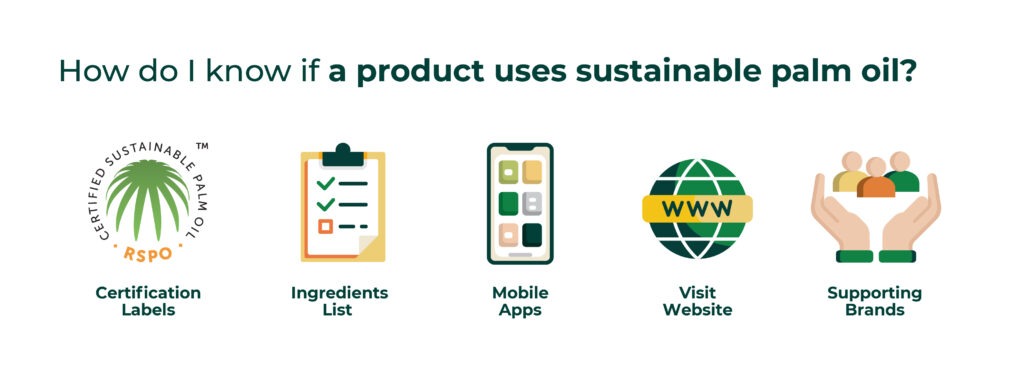
- Certification labels
Credible certification like the Roundtable on Sustainable Palm Oil (RSPO) label on packaging, the label indicates that the palm oil meets specific environmental and social sustainability standards
- Ingredient List
Certified products will clearly state “sustainably source Palm Oil” or “RSPO certified”
- Mobile Apps or Online tools
Apps developed by environmental organizations can be used to scan product barcodes and check whether a brand is committed to sourcing palm oil sustainably.
- Visiting brand website
Check company websites for transparency on palm oil sourcing and certification, as these commitments are often published online.
- Supporting brands with clear sustainable policies
Some brands demonstrate strong sustainability commitments by actively reporting their progress through sustainability reports and participating in initiatives that promote the use of sustainable palm oil. Supporting these brands helps drive greater transparency and accountability across the industry.
14. Should palm oil be completely avoided or boycotted?
Boycotts of palm oil will neither protect nor restore the rainforest, whereas companies undertaking actions for a more sustainable palm oil industry are contributing to a long-lasting and transparent solution.
Paris, 26 June 2018 (IUCN) – Banning palm oil would most likely increase the production of other oil crops to meet demand for oil, displacing rather than halting the significant global biodiversity losses caused by palm oil, warned an IUCN report published today.
Although conventional palm oil production has considerable negative impacts, conservation organizations such as the World Wide Fund for Nature (WWF) agree that boycotting palm oil is not the answer.
15. How do I know if a product uses sustainable palm oil?
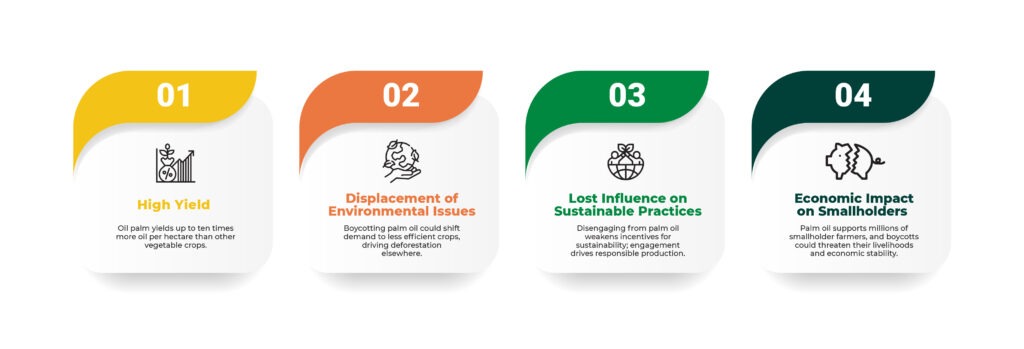
- High yield
Oil palm stands out as one of the most efficient oil-producing crops, yielding more oil per hectare than any other vegetable oil source. Producing the same amount of oil from alternatives such as soybean, rapeseed, or sunflower would require up to 10 times as much land.
- Displacement of environmental issues
A widespread boycott of palm oil would only shift demand to less efficient alternatives. This would increase pressure on other forests and ecosystems worldwide, such as the Amazon rainforest, where soy production is a major driver of land-use change.
- Lost influence on sustainable practices
A boycott would lessen the motivation for palm oil producers to adopt better practices. Remaining engaged with the industry enables companies and consumers to leverage their purchasing power to advocate for more responsible, sustainable production methods.
- Economic impact on smallholders
The palm oil industry serves as a crucial source of livelihoods for millions of smallholder farmers in developing countries. Boycotting could severely impact these communities, driving them deeper into poverty and stripping away the economic stability that oil palm cultivation provides.
16. Can Palm Oil Really Be Sustainable?
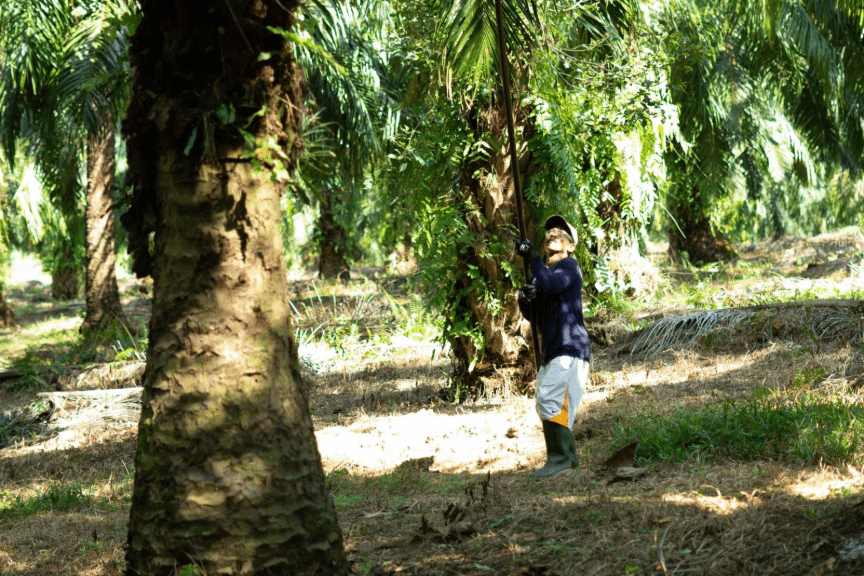
Sustainable palm oil is not perfection; it is about reducing harm and improving practices across the entire value chain. Palm oil remains the most efficient oil crop, producing four to ten times more oil per hectare than alternatives such as soybean or sunflower.
Due to its high yield, replacing palm oil with other vegetable oils would require significantly more land, likely driving even greater deforestation and environmental pressure. In addition, millions of smallholder farmers worldwide rely on palm oil cultivation as a primary source of income, making it economically and socially vital to many rural communities.
Leading conservation bodies such as WWF, the Rainforest Alliance, and IUCN emphasize that removing palm oil from supply chains is neither feasible nor environmentally advantageous. They advocate for enhancing production practices rather than abandoning the crop.
So… can palm oil really be sustainable?
Yes — but only if the industry continues to improve. Sustainable palm oil requires:
- No deforestation
- No planting on peatlands
- Protecting important forest areas (HCV/HCS)
- Fair treatment of workers
- Safe, transparent, and traceable supply chains
- Support for smallholder farmers who depend on palm oil
When these elements come together, palm oil can move toward truly sustainable production. Businesses also play an important role by choosing certified sustainable palm oil, thereby raising industry standards and pressuring producers to adopt better practices.
17. Why do companies still use palm oil?
Companies continue to use palm oil because it is highly efficient, versatile, and challenging to replace. It is the world’s most productive oil crop, which makes it affordable, stable in supply, and far less land-intensive than other vegetable oils. It also performs well in many types of products — from food and cosmetics to cleaning items and biofuels — in ways other oils cannot easily match.
Here are why companies still rely on it:
- High efficiency: produces more oil per hectare than any other crop.
- Cost-effective: stable pricing and reliable supply.
- Versatile: Working in food, cosmetics, cleaning products, and even biofuels.
- Better performance: offers texture, stability, and shelf-life benefits that many edible oils cannot mimic.
- Low land use: Requires significantly less land than alternative oils
On top of that, millions of smallholder farmers depend on palm oil to support their families. This makes it even more important for companies to keep using palm oil, but to source it responsibly from sustainable producers who protect both people and the environment.
18. Is sustainable palm oil real or just greenwashing?
Many people question whether “sustainable palm oil” is genuinely meaningful or simply a marketing buzzword. The reality is that it can be meaningful, but only when supported by strong standards, proper monitoring, and genuine commitment from companies.
There are credible frameworks designed to make palm oil production more responsible. These include certification schemes like the Roundtable on Sustainable Palm Oil (RSPO), Indonesia Sustainable Palm Oil (ISPO), Malaysia Sustainable Palm Oil (MSPO), as well as No Deforestation, No Peat, No Exploitation (NDPE) policies.
So why do people call it greenwashing?
There are still obstacles to overcome:
- Some companies claim “sustainable” without complete transparency.
- Certification systems have gaps, and enforcement varies.
- Not all producers follow rules consistently.
- Some brands use sustainability language loosely in marketing.
This inconsistency creates the impression that the entire concept is just greenwashing, even though many producers are improving.
Although the word “sustainability” is often overused and can feel vague in many contexts, palm oil remains a sector where genuine sustainable practices truly matter, because they enable access to global markets. Palm oil plays a significant role in the global economy and is found in everything from food and cosmetics to cleaning products and biofuels. Sustainable palm oil does exist, but it is not perfect yet.
Its progress depends on stronger monitoring, greater supply-chain transparency, and continued support for smallholder farmers. By understanding palm oil more deeply and recognizing what real sustainability should look like, producers, consumers, and policymakers can work together to build an industry that is more transparent, responsible, and environmentally sound.
References:
- Turner, E. C., Snaddon, J. L., Ewers, R. M., Fayle, T. M., & Foster, W. A. (2011). The impact of oil palm expansion on environmental change: Putting conservation research in context. In M. A. D. S. Bernardes (Ed.), Environmental impact of biofuels (pp. 21-42). IntechOpen. https://doi.org/10.5772/2026
- WWF-International. (2021, September). Sustainable palm oil uptake in Asia: Where do we go from here? https://wwfint.awsassets.panda.org/downloads/sustainable_palm_oil_uptake_in_asia_sept_2021.pdf
- Palm Oil Magazine. (2025, April 25). USDA projects Indonesia’s palm oil production to reach 47 million tons in 2025/26. https://www.palmoilmagazine.com/market/2025/04/25/usda-projects-indonesias-palm-oil-production-to-reach-47-million-tons-in-2025-26/
- Council of Palm Oil Producing Countries. (2025). Annual Report Market & Outlook 2025. https://cpopc.net/backend/galeri/resources/20250116_163044_annual_report_market_outlook_2025_mobile_version.pdf
- Reuters. (2025, April 22). Palm oil demand from China and India expected to rise as prices become competitive, says MPOC. Retrieved from https://www.reuters.com/markets/commodities/palm-oil-demand-china-india-expected-rise-prices-become-competitive-says-mpoc-2025-04-22/
- Sowcharoensuk, C. (2025, March 21). Industry Outlook 2025–2027: Palm Oil Industry. Krungsri Research. https://www.krungsri.com/en/research/industry/industry-outlook/agriculture/palm-oil/io/plam-oil-industry-2025-2027